

Guide
What drives the cost of a private-label amenity range?
The cost of a private-label range is driven mainly by the formula and fragrance, the packaging and its decoration, the quantity per product and any one-off development or tooling. Hidden costs such as storage, write-offs and reprints matter too, so compare total cost over the range's life, not just the unit price.
By Hemang Jain, Founder, Anadoris
Why compare drivers, not just prices?
Two quotations for what looks like the same bottle of shampoo can differ for many reasons: a richer formula, a more expensive fragrance, a heavier bottle, a pump instead of a cap, direct print instead of a label, or simply a different quantity. Comparing headline unit prices without understanding the drivers leads to choices that look cheap and turn out expensive.
Understanding drivers also gives you levers. If a quotation is above budget, you can change the driver that matters least to your guests rather than accepting a lower-quality product overall.
It also helps to separate one-off costs from recurring ones. Development, artwork set-up and tooling are paid once; formula, packaging and filling are paid on every order. A range with higher one-off costs but lower recurring costs can be cheaper over its life, and the reverse is also true.
What are the main cost drivers?
This table lists the main cost drivers in a private-label range and how buyers commonly manage them.
| Driver | Why it affects cost | Common lever |
|---|---|---|
| Formula | Ingredient quality and complexity | Use a stock formula; focus richer formulas on key products |
| Fragrance | Fragrance quality and level | Library fragrance; agree a balanced level |
| Bottle | Material, weight, shape, custom tooling | Stock bottle in one family |
| Closure | Pumps and special caps cost more than simple caps | Match closure to use; pumps only where needed |
| Decoration | Number of colours, foils, sleeves, set-ups | Fewer colours; labels for variants |
| Cartons and packing | Printed cartons, inserts, gift boxes | Plain shipping cartons for in-room stock |
| Quantity | Set-up costs spread over more units | Fewer variants; pooled orders |
| One-off costs | Development, artwork set-up, tooling | Stock components; phased development |

How does quantity affect cost?
Each production run and each printed component carries set-up work that costs much the same whatever the quantity. Larger quantities spread that work over more units, so the unit cost falls. That is why minimums exist; for branded ranges they typically start from around 5,000 units per product, confirmed with the quotation.
But a lower unit cost only saves money if the stock is used. Larger orders tie up cash and storage and risk write-offs if products expire or artwork changes. The cheapest order is the largest quantity you will use comfortably within shelf life.
Talk to the manufacturer about phasing. Sometimes components can be bought at their minimum and filled in more than one run, which spreads cash outlay while keeping component costs efficient.
What are the hidden costs?
- Storage: space in a warehouse or hotel store, and handling.
- Write-offs: stock that expires, is damaged or becomes obsolete after a design change.
- Reprints: components printed with an error or old artwork.
- Delays: buying stopgap products when private-label stock runs out.
- Staff time: approvals, stock control and distribution.
- Waste in use: product left in bottles or over-dispensed by closures.
Add these to your comparison by estimating them roughly for each option. Even rough figures show when a quotation that looks cheaper per unit is likely to cost more in practice.
How do you measure cost in use?
For hotels, the most useful measure is cost per occupied room: total amenity spend divided by occupied room nights. It captures the effect of format, closure and usage, not just unit price. A cheaper miniature that is replaced every stay may cost more per room than a dearer refillable format.
See how to calculate amenity cost per occupied room and refill economics.
For retail or D2C ranges, the equivalent measure is cost per unit sold, including packaging, shipping materials and returns, compared with the selling price.
Where should you spend, and where save?
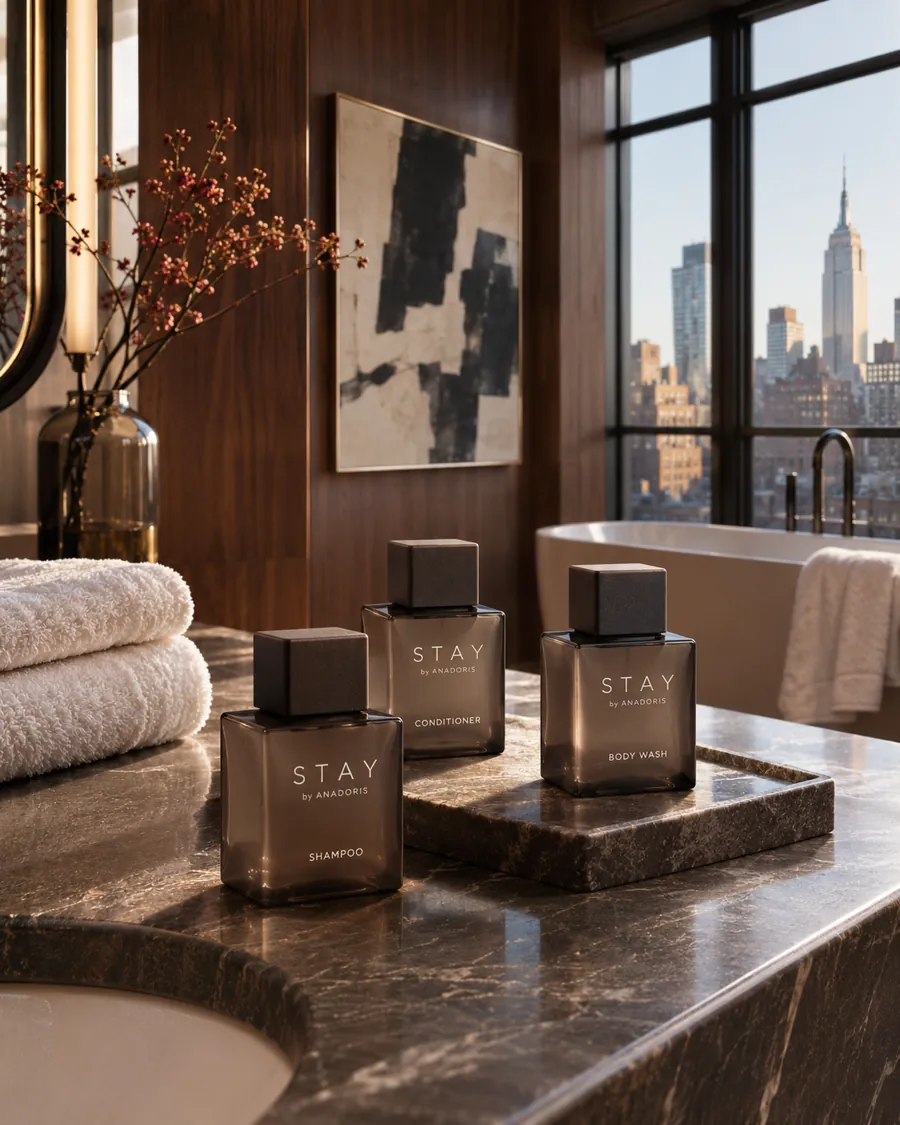
Spend where guests notice: fragrance, the feel of the main products and the closure they touch. Save where they do not: plain shipping cartons for in-room stock, a stock bottle with a good finish, fewer decoration colours, labels rather than multiple print set-ups. A clear brief that says what matters most helps the manufacturer propose savings in the right places.
Review the balance after launch. Guest feedback and usage data may show that a costly feature goes unnoticed, or that a saving has caused complaints, and the next order is the time to adjust.
Asking for a useful quotation
- Ask for one-off costs and unit costs separately.
- Ask for prices at more than one quantity.
- Ask which driver most affects each product's price.
- Ask what is included: testing, cartons, delivery.
For how STAY builds quotations, see private label or the FAQ.
Questions on this topic
Why do private-label quotations differ so much?
Differences in formula, fragrance, packaging, decoration, quantity and one-off costs all affect price, so compare the drivers behind each quotation.
Does ordering more always reduce cost?
Unit cost usually falls with quantity, but storage, write-offs and tied-up cash can outweigh the saving if stock is not used in time.
How do hotels measure amenity cost properly?
Cost per occupied room, calculated as total amenity spend divided by occupied room nights, captures the real cost in use.
Keep reading
- Private label, white label or bespoke: what is the difference?
- How do you brief a private-label manufacturer?
- How to choose a fragrance for an own-brand amenity range
- Choosing bottle shape and material for a private-label range
- How to stock an Airbnb bathroom
- Hospital and clinic bathroom amenities: what to consider
- Gym locker room amenities: a practical checklist
Looking for supply? See Hotels & resorts, browse the product range or request samples.