

Guide
What must go on an own-brand cosmetic label?
An own-brand cosmetic label usually needs the product name and function, the ingredient list, the nominal contents, the name and address of the business responsible, a batch code, a date marking or period-after-opening symbol, and any warnings or directions. The exact list depends on the market where the product is sold or supplied, so check it with your market's regulator.
By Hemang Jain, Founder, Anadoris
Why does labelling matter for private label?
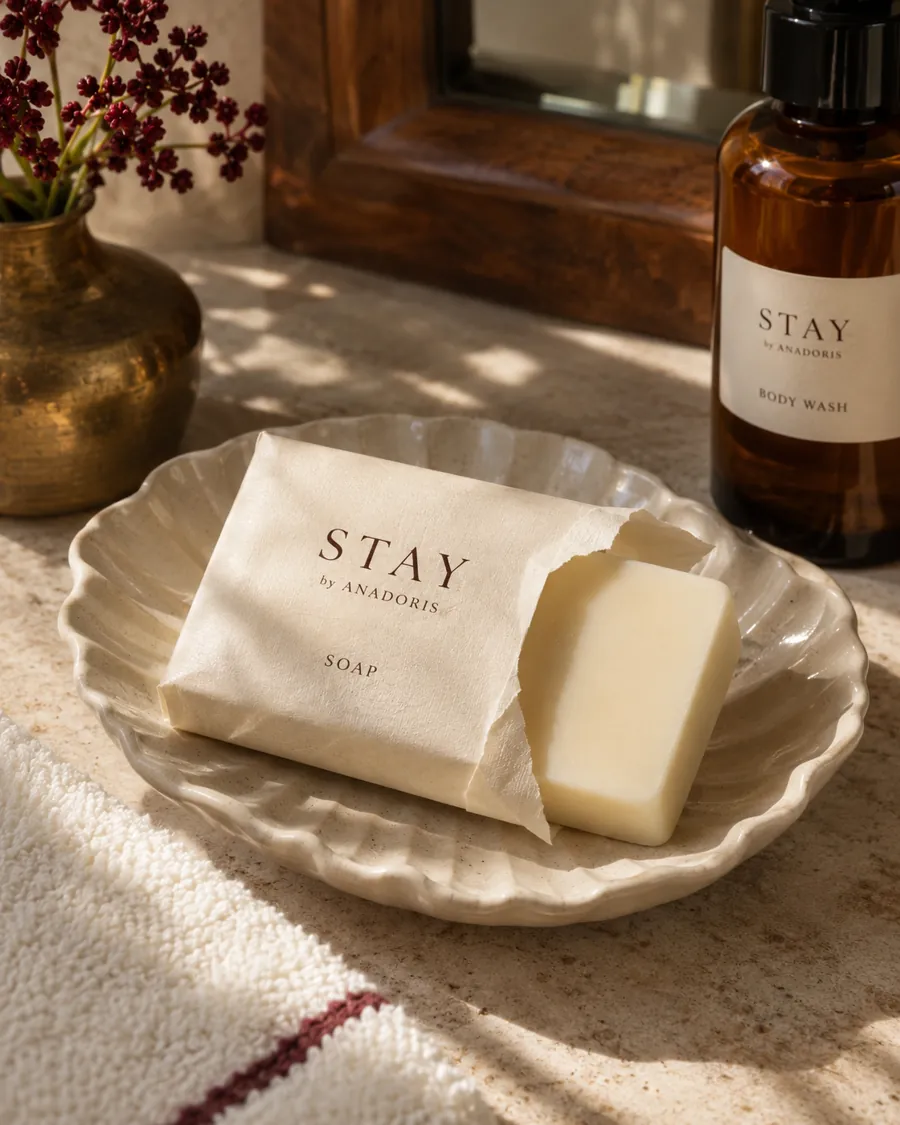
When your brand is on the product, the label is your responsibility as much as the design. A missing ingredient list or wrong address can stop products being sold, force a reprint or create problems if a guest has a reaction. Labelling also has to fit on small packs, which is why it shapes design decisions from the start.
This article describes elements commonly required in many markets. It is general guidance, not legal advice. Rules differ between countries and change over time.
Hotel amenities are sometimes assumed to be exempt because they are given free in a room. In many markets they are still cosmetic products made available to consumers, and the same labelling rules apply. Check this with your regulator rather than assuming an exemption.
Which elements commonly appear?
This table lists label elements commonly required for cosmetic products and what each one means. Requirements vary by market.
| Element | What it means | Notes |
|---|---|---|
| Product name and function | What the product is and does, such as shampoo | Function must be clear if not obvious from the name |
| Ingredient list | Ingredients in a standard naming format, often INCI | Usually supplied by the manufacturer |
| Nominal contents | Quantity by weight or volume | Very small packs may be exempt in some markets |
| Responsible business | Name and address of the business responsible in the market | In the EU, the Responsible Person |
| Batch code | Code linking the unit to its production batch | Often printed during filling |
| Date marking | Minimum durability date or period-after-opening symbol | Depends on product shelf life and market |
| Warnings and directions | Precautions and how to use | Required where relevant |
| Country of origin | Where the product was made | Required in some markets |
What is INCI?
INCI stands for International Nomenclature of Cosmetic Ingredients. It is a standard system of names for cosmetic ingredients, used on labels in many markets so that the same ingredient has the same name everywhere. Ingredients are usually listed in descending order of weight, with ingredients below a certain level allowed in any order, depending on the rules.
Your manufacturer should supply the ingredient list in the correct format. Paste it rather than retyping it, and update it whenever the formula or fragrance changes.
Fragrance is usually listed under a single term such as parfum, but some fragrance allergens may need to be listed individually above certain levels in some markets. Ask the manufacturer to confirm which, if any, apply to your products.
What is a Responsible Person?
In the EU, Regulation (EC) No 1223/2009 requires every cosmetic product placed on the market to have a designated Responsible Person, a business or person based in the EU who ensures the product complies, holds the product information file and is named on the label. The UK has a similar requirement for its market.
Other markets use different systems, such as registration with a regulator or a named importer. If you supply products across borders, establish who fulfils this role in each market before artwork is finalised.
How do you fit everything on a small pack?
- Keep the front clean: brand and product name.
- Put ingredients, address and symbols on the back or side.
- Leave a defined space for the batch code.
- Use the smallest legible text size your printer and market allow.
- Check whether some information may go on an outer carton or leaflet for very small containers in your market.
Settle the text before final artwork, not after. See what hotels should ask about ingredients for related questions.
Ask your printer for its minimum legible text size and check it against any minimum your market sets. Small, light-coloured text on a clear bottle can become unreadable, so test contrast on a physical proof.
What about claims?
Words such as "natural", "organic", "hypoallergenic", "sensitive" or "dermatologically tested" are claims. They need evidence and, in many markets, must meet specific criteria. Sustainability claims such as "recyclable" also need care. Agree claims with your manufacturer before design, and remove any you cannot support. See making sustainability claims you can defend.
A labelling checklist before approval
- Product name and function correct.
- Ingredient list matches the current formula.
- Contents correct with proper units.
- Responsible business and address correct for the market.
- Batch code space and date marking agreed.
- Warnings included where needed.
- Claims supported and agreed.
Check the final position with your market's regulator or a regulatory adviser. More definitions are in the glossary.
Keep the approved label text with the artwork register, so any future change to the formula prompts a check of the label.
Questions on this topic
Do hotel amenities need an ingredient list?
In many markets, yes, cosmetic products supplied to consumers need an ingredient list. Check the rules for your market.
What does PAO mean on a label?
PAO means period after opening. It is shown by an open-jar symbol with a number of months, indicating how long the product stays good once opened.
Who is the Responsible Person for my own-brand products?
In the EU, it is the business or person designated under Regulation (EC) No 1223/2009 to ensure compliance. Confirm who fills this role before artwork is finalised.
Keep reading
- Private label, white label or bespoke: what is the difference?
- How do you brief a private-label manufacturer?
- How to choose a fragrance for an own-brand amenity range
- Choosing bottle shape and material for a private-label range
- How to stock an Airbnb bathroom
- Hospital and clinic bathroom amenities: what to consider
- Gym locker room amenities: a practical checklist
Looking for supply? See Hotels & resorts, browse the product range or request samples.