

Guide
Why launch a small own-brand range first, and what to include?
Launching a small own-brand range first means putting your brand on the few products guests or customers use most, proving them in real use, and only then adding more. It lowers the stock you hold, shortens approvals and gives you real feedback before you commit to a full range.
By Hemang Jain, Founder, Anadoris
Why start small?
A first own-brand range carries more unknowns than it appears to. You do not yet know how guests will react to the fragrance, how quickly stock will move, how housekeeping will handle the new packs or how the artwork will look after months in a steamy bathroom. A small range lets you find out at low risk.
Every product you add brings its own approvals, its own minimum and its own storage. Five products mean five sets of proofs and five quantities to hold. Two or three products mean the team can give each one proper attention, and the launch is far less likely to stall on a single late decision.
Starting small is not the same as starting cheap. The products you launch should be as good as the full range will be, because they set the standard every later product must match.
Which products belong in a first range?
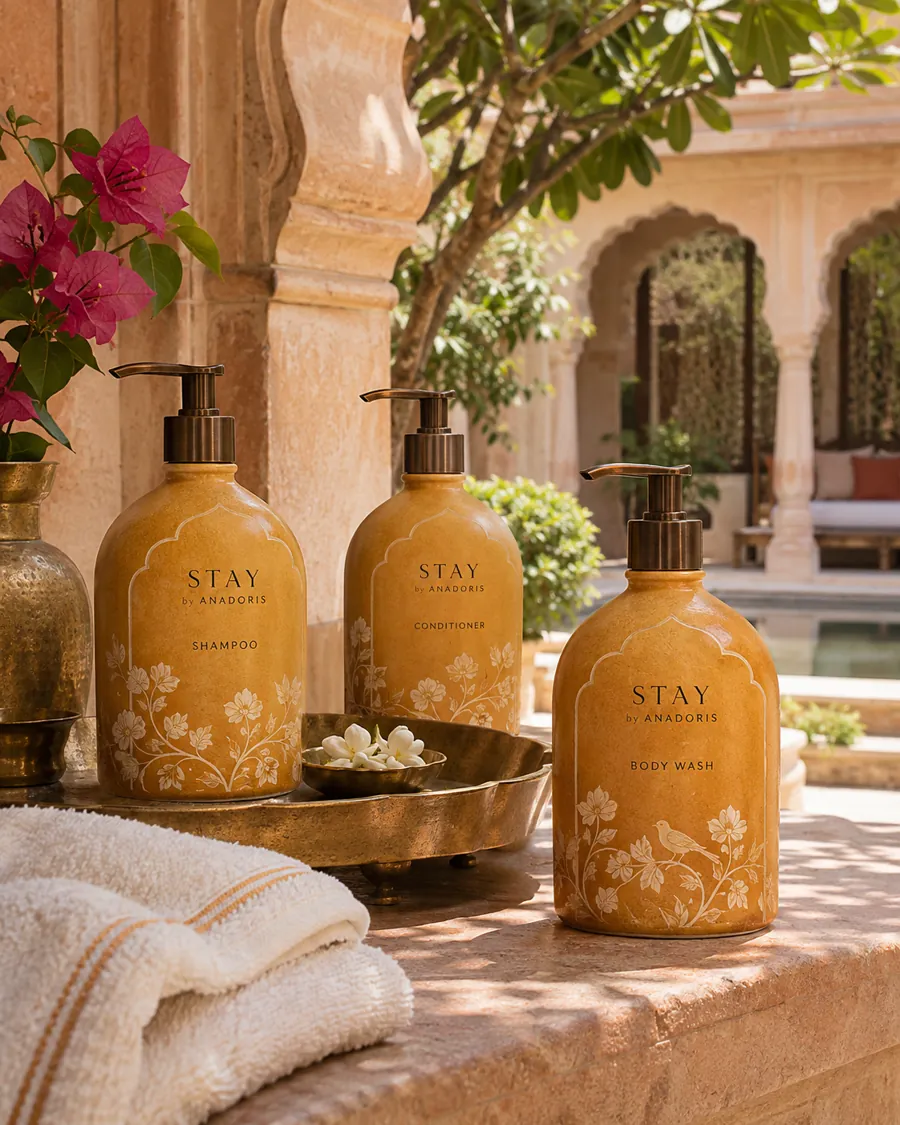
Choose the products that are used most often and seen most clearly. For most settings that means:
- Hotels and short stays: shampoo, body wash and either conditioner or body lotion.
- Spas: one treatment product, such as a body oil or lotion, plus a matching retail size.
- Gyms: body wash and shampoo, often in dispenser refills.
- Small D2C brands: one hero product and one companion, such as a body wash and a lotion.
Leave out low-visibility items such as shower caps, sewing kits and cotton buds. These can stay as neat stock items until the core range has proved itself.
What should a small range still get right?
A small range is the foundation for everything that follows, so a few decisions deserve full attention even at this stage:
- The fragrance: it will carry into later products, so choose one you are happy to keep.
- The bottle family: pick a stock bottle that comes in several sizes, so later products can match.
- The visual system: logo placement, colour, typography and how product names appear.
- The name: check that it is free to use in your markets before it goes on packaging.
Settling these now means later products are additions to an established system, not new projects.
How does a small range compare with a full launch?
This table compares launching a small first range with launching a full range at once. Neither is right for everyone, but most first-time buyers benefit from starting small.
| Point | Small first range | Full range at once |
|---|---|---|
| Approvals | Few, focused | Many, often delayed by one item |
| Stock held | Lower | Higher, across more items |
| Learning | Real feedback before expanding | Feedback after everything is committed |
| Guest impression | Branded where it matters most | Branded everywhere from the start |
| Risk if something is wrong | Limited to a few products | Spread across the whole range |
How do you learn from the first range?
Decide in advance what you want to learn, and how you will find out:
- Guest reaction: read reviews and ask front-desk and spa staff what guests say.
- Usage: track how much of each product is used per occupied room or per visit.
- Operations: ask housekeeping whether the packs are easy to handle, restock and clean.
- Durability: check how labels and caps look after a few months of use.
- Waste: note how much is left in returned bottles.
Review the results before planning the next products. The findings may change the fragrance strength, the fill size or the closure, and it is far easier to change these before the range grows.
When is it time to expand?
Expand when the first products are working well, the team is comfortable with them and you have a clear reason for each new item, such as guest requests, a gap in the bathroom set or a retail opportunity. Expanding simply because the range feels small is a weaker reason.
Add products in a planned group rather than one at a time, so they share approvals and reorder timing with existing items. Start each addition from the existing specification and artwork, and approve it side by side with the products already in use.
Getting started
Write a one-page brief for the first products only, with a note of products you expect to add later, so the manufacturer can choose components that will extend. If you want to picture a starter set, the design-your-collection configurator lets you combine formats and finishes, and the private label page explains how a first range is usually scoped.
Agree a review point with your team before launch, for example after the first reorder, when you will look at the findings together and decide what comes next. A date in the calendar turns "we will learn from it" into an actual decision.
Questions on this topic
How many products should a first own-brand range have?
There is no fixed number, but many first ranges start with two to four core products, such as shampoo, body wash and conditioner or lotion.
Will a small range look incomplete to guests?
Not if the most visible products are branded. Low-visibility items can remain neat stock products until the range grows.
Can I change the fragrance after the first range?
Yes, but it means new approvals and possibly new artwork, so it is better to choose a fragrance you are happy to keep.
Keep reading
- Private label, white label or bespoke: what is the difference?
- How do you brief a private-label manufacturer?
- How to choose a fragrance for an own-brand amenity range
- Choosing bottle shape and material for a private-label range
- How to stock an Airbnb bathroom
- Hospital and clinic bathroom amenities: what to consider
- Gym locker room amenities: a practical checklist
Looking for supply? See Hotels & resorts, browse the product range or request samples.