

Guide
Co-branding a supplier's collection: when does it make sense?
Co-branding means adding your name or logo to a supplier's existing collection, so both names appear on the pack. It makes sense when you want a branded presence quickly and at lower minimums than a full private-label range, and when the collection already suits your guests.
By Hemang Jain, Founder, Anadoris
What is co-branding?
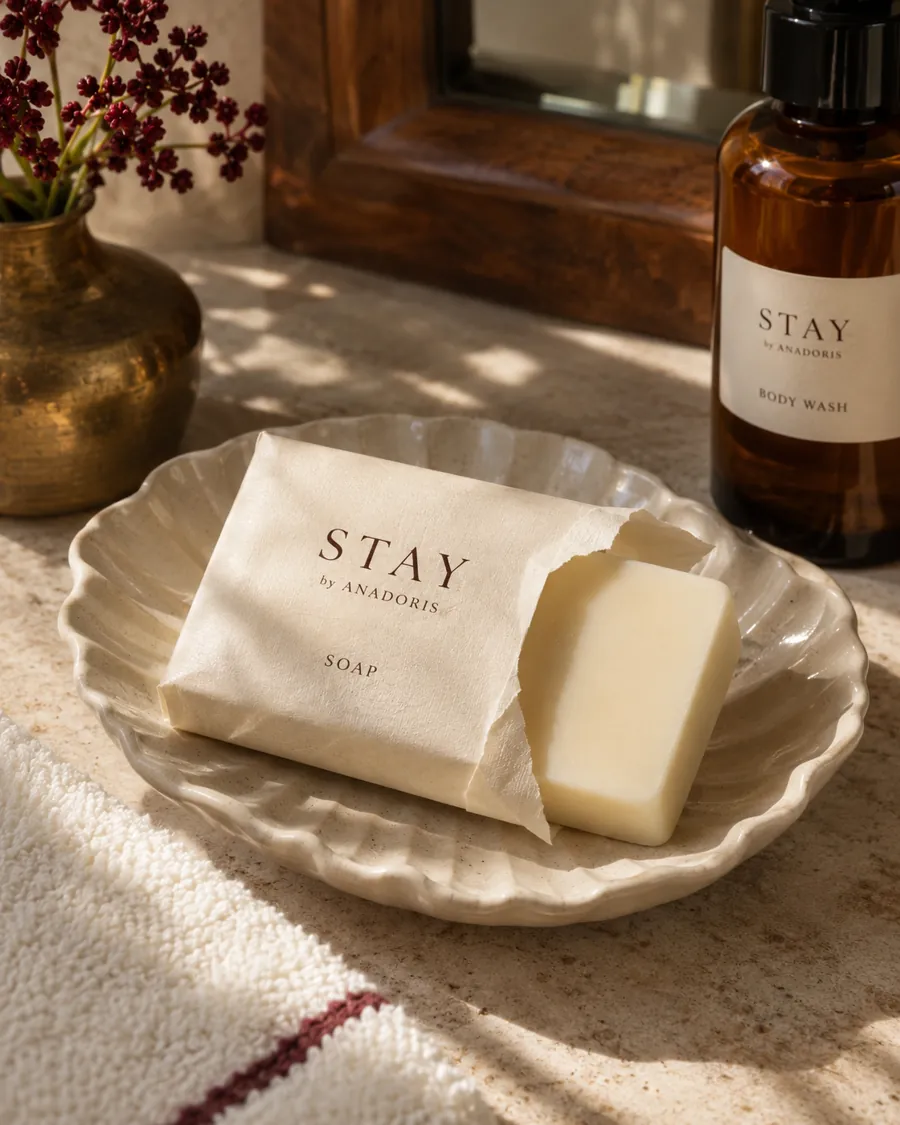
Co-branding is a supplier's existing product range carrying your name or logo alongside the collection's own name. The formula, fragrance and packaging stay as they are; the decoration adds your brand, often on the front panel or on a separate label.
It sits between buying a catalogue product unchanged and commissioning a private-label range. Guests see your name and a coherent, established collection. You gain recognition without taking on every design decision yourself.
The decoration can be simple, such as a small printed logo or a neat label, or more prominent, such as a front panel redesigned to lead with your name. The more the pack changes, the closer the project moves towards private label, with the extra approvals that brings.
How does co-branding compare with full private label?
This table compares buying a catalogue collection, co-branding it and building a full private-label range. Terms vary by supplier.
| Point | Catalogue collection | Co-branded collection | Full private label |
|---|---|---|---|
| Whose name appears | Collection name only | Collection name and yours | Yours only |
| Fragrance and formula | Fixed | Fixed | Chosen or developed for you |
| Packaging | Fixed | Fixed, with your logo added | Chosen and decorated for you |
| Approvals | Few | Logo placement and proofs | Full sampling and artwork rounds |
| Minimums | Lowest | Usually lower than private label | Set per product, often higher |
| Distinctiveness | Low | Moderate | High |
When does co-branding make sense?
- You need branded products soon, for an opening, relaunch or event, and cannot wait for full sampling rounds.
- Your volumes are modest, so private-label minimums would mean holding too much stock.
- An existing collection already fits your interiors and guests well.
- You are testing private label, and want to see how guests react to seeing your name on amenities.
- You value the collection's own identity, for example a fragrance story that complements your property.
Co-branding can also suit properties under a management or franchise arrangement, where the brand standard allows a property name on amenities but not a fully separate range. Check what your brand standards permit before approaching a supplier.
When is full private label the better choice?
Co-branding is less suitable when you want a fragrance that is yours alone, when your brand guidelines need full control of the pack, when you plan to sell the products at retail as your own line, or when the collection's style competes with your own identity.
It is also worth thinking about the long term. If co-branding works well, will you want to move to your own range later? If so, choose a collection whose fragrance and bottle could carry over, so the transition is gradual rather than a sudden change guests notice.
Consider retail too. If guests ask to buy the products, a co-branded pack sells the supplier's collection as much as your property. That may be fine, but if you want retail revenue to build your own brand, full private label gives you a product that is yours to sell.
How should the two names sit together?
Decide which name leads. In most co-branded amenities the property's name leads on the front, with the collection name smaller or on the back. Some properties prefer the reverse, letting a well-designed collection speak while their logo appears as a quiet mark.
- Agree logo size and placement on each component.
- Check that both names remain legible at small sizes on miniatures.
- Use your colour references for your logo, and check them on a physical proof.
- Keep the collection's required text, ingredients and address intact.
Ask for proofs of every component carrying your logo, including outer cartons if guests will see them, for example on a retail shelf or in a gift set.

What should you agree before your name goes on?
- Approval rights over how your logo is used, on packs and in any supplier marketing.
- Whether the supplier may show your property as a user of the collection.
- What happens to unused co-branded stock if either side ends the arrangement.
- Notice of any change to the collection's formula, fragrance or packaging.
- Ownership of your logo files and any artwork created for the co-branded pack.
Notice of change is especially important. If the collection is updated, your co-branded stock should change only when you agree.
Keep a copy of the approved co-branded proof and the agreement together. When stock is reordered, check that the logo position and colour still match, since collection packaging is sometimes updated between orders.
Practical next steps
Short-list collections that suit your guests, ask for samples, and check logo placement on a physical proof before ordering. Browse existing ranges on the collections page, and compare with the full private label route if your volumes and timeline allow.
Questions on this topic
Is co-branding cheaper than private label?
It often involves lower minimums and fewer approvals because the formula and packaging are unchanged, but pricing depends on the supplier and quantities.
Can I move from co-branding to my own private-label range later?
Yes. Choosing a collection whose fragrance and bottle could carry over makes the move gradual for guests.
Whose name should appear larger on a co-branded pack?
There is no rule. Most properties lead with their own name, but some prefer a quiet logo alongside a strong collection identity.
Keep reading
- Private label, white label or bespoke: what is the difference?
- How do you brief a private-label manufacturer?
- How to choose a fragrance for an own-brand amenity range
- Choosing bottle shape and material for a private-label range
- How to stock an Airbnb bathroom
- Hospital and clinic bathroom amenities: what to consider
- Gym locker room amenities: a practical checklist
Looking for supply? See Hotels & resorts, browse the product range or request samples.