

Guide
How to budget amenities for short-stay rentals
Short-stay rentals should budget amenities per stay rather than per night, because most items are replaced at changeover regardless of how long the guest stayed. Choosing sizes and formats that match typical stay length is the biggest lever on cost.
By Hemang Jain, Founder, Anadoris
Why per stay, not per night?
Hotels usually measure amenity cost per occupied room night. In a short-stay rental, housekeeping happens mainly at changeover, so what drives cost is the number of stays and what is replaced each time. A guest who stays one night and a guest who stays several may use similar amounts of some items, such as dental kits or soap, while using more shampoo and body wash on longer stays.
Budget per stay, then check per night for comparison with other properties. For what to stock, see how to stock a short-stay bathroom.
The per-stay budget formula
For each item:
Cost per stay = units replaced per stay × landed unit cost
For items that last several stays, such as a large bottle or a dispenser refill, use the fraction used per stay instead: millilitres used per stay ÷ millilitres per container × container cost. Add all items, then multiply by the number of stays forecast for the year.
If stays vary a lot in length, split them into short and long, with a usage figure for each.
An illustrative operator with S stays a year, replacing a set of K items at each changeover, would budget S × the cost of one set, plus the share of larger bottles and refills used. Writing it this way makes it easy to see what happens if the number of stays rises or the set changes.

Choosing sizes and formats
| Format | Suits | Cost behaviour | Watch for |
|---|---|---|---|
| Miniatures | Shorter stays, guests who expect sealed items | Replaced each stay; leftovers often wasted | Waste on very short stays |
| Larger bottles | Longer stays, apartments with kitchens | Lower cost per millilitre; may last several stays | Must be clean and refreshed at changeover |
| Wall dispensers | Units with regular turnover | Lowest product cost; equipment needed | Guests must trust they are clean and full |
| Refill packs | Operators managing many units | Bulk buying; refill on site | Hygiene and handling routine |
Managing stock across several units
- Keep one central store and a small kit per unit.
- Set a par level for each unit: the stock needed for one or two changeovers.
- Restock units from the central store at each cleaning visit.
- Count central stock regularly against stays completed.
- Reorder centrally once stock falls to the reorder point.
Using the same products across every unit simplifies buying and lets you reach better quantity prices. If you manage enough units, a branded range may become realistic; see buying small quantities for how minimums work at small scale.
What guests in short stays notice
- Whether items look fresh and sealed or clearly clean.
- Whether the essentials are there: shampoo, conditioner, body wash, hand soap.
- Whether quantities suit the length of stay.
- Presentation: a tidy tray or set looks deliberate.
Reviews often mention missing or half-empty bottles, so a changeover checklist that confirms levels is worth more than an extra item. A short list on the cleaner's phone or a laminated card in each unit, ticked at every changeover, keeps standards even when different people clean.
Common budgeting mistakes
- Budgeting per night and underestimating changeover replacement.
- Buying many brands for different units, losing any volume benefit.
- Ignoring cleaning staff time spent restocking.
- Leaving partly used large bottles that guests find off-putting.
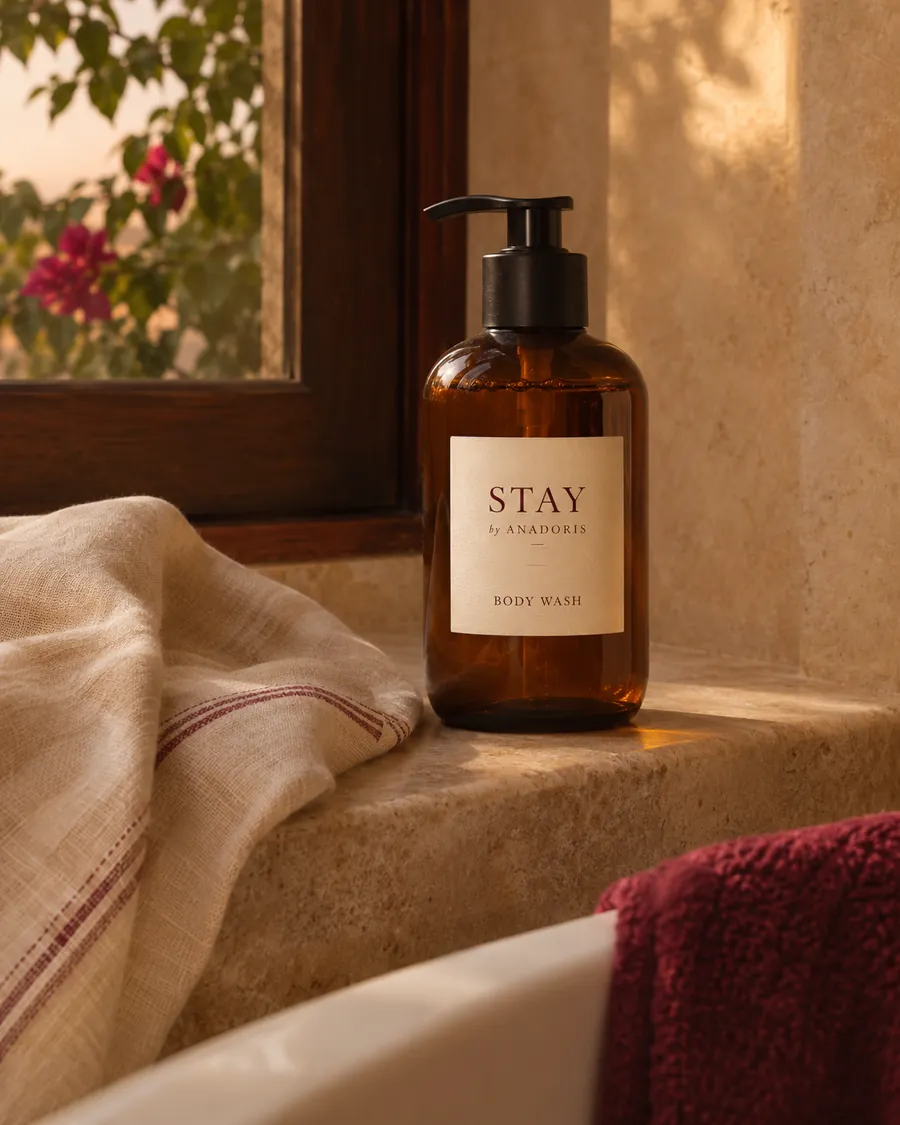
STAY supplies sizes from miniatures to bulk refills, filled from 3 ml to 25 litres; see our products to match formats to your stays.
Questions on this topic
Are dispensers acceptable in short-stay rentals?
Many guests accept them if they look clean and well maintained. Some operators combine them with sealed miniatures for key items.
Should cleaning time be in the amenity budget?
Track it separately, but include it when comparing formats, since refilling and replacing take different amounts of time.
How much stock should each unit hold?
Enough for one or two changeovers, restocked from a central store at each cleaning visit.
Can a small operator have a branded range?
Possibly, if total volume across units reaches the minimum within shelf life. Otherwise start with a ready range.
Keep reading
- How to build an annual hotel amenity budget
- Setting an amenity cost target and tracking variance
- What drives the unit cost of an amenity bottle?
- Total cost of ownership for amenities: a working method
- How to stock an Airbnb bathroom
- Hospital and clinic bathroom amenities: what to consider
- Gym locker room amenities: a practical checklist
Looking for supply? See Hotels & resorts, browse the product range or request samples.